
When an idea feels hard to explain, ordinary words may not be enough to make it clear and engaging. Creative comparisons can turn complicated thoughts into familiar images, helping readers understand even the most challenging concepts. Similes for Complex Ideas let writers describe confusing situations, layered emotions, and complicated subjects in a more natural, memorable way. Whether you’re writing poems, stories, essays, speeches, or everyday conversations, the right simile can add clarity, creativity, and depth to your words. In this guide, you’ll discover unique examples with simple meanings to make your writing more expressive, relatable, and interesting.
Definition of Similes For Complex
Similes for complex ideas describe complicated ideas, situations, emotions, systems, or thoughts by comparing them with something easier to understand. They usually use words such as “like” or “as” to show the connection.
For example, saying “The problem was like a maze with no clear exit” helps readers imagine confusion and difficulty more clearly than simply saying “The problem was complex.”
What Is a Simile?
A simile compares two different things using words such as “like” or “as.” Writers use similes to create vivid images, explain difficult ideas, emphasize qualities, and make language more memorable.
Example
- The puzzle was like a maze with hundreds of turns.
- Her thoughts were as tangled as a ball of thread.
- The situation changed like a storm moving across the sea.
- His explanation was as complicated as an ancient map.
A simile differs from a metaphor because a simile openly signals the comparison, while a metaphor directly describes one thing as another. (Literary Devices)
Why Use Similes For Complex Ideas in Writing?
- Make difficult ideas clearer: A familiar comparison can help readers understand an unfamiliar concept.
- Create vivid imagery: Readers can picture a complicated situation instead of simply being told about it.
- Add emotional depth: A comparison can show whether complexity feels confusing, exciting, frustrating, or mysterious.
- Make writing memorable: Creative comparisons often stay in the reader’s mind longer than plain descriptions.
- Improve storytelling: Similes can turn an ordinary explanation into a more engaging scene.
- Strengthen abstract writing: Writers can give shape to ideas such as confusion, uncertainty, decision-making, or complicated relationships.
- Add personality: A clever comparison can make your writing sound more natural and expressive.
- Support explanation: Figurative language can help simplify concepts without removing their deeper meaning.
- Types of Similes
Similes for complex ideas can take several forms. Some focus on mental difficulty, while others emphasize tangled situations, emotional layers, or complicated systems. Understanding these approaches helps you choose a comparison that matches your intended meaning.
Descriptive Complex Similes
Descriptive similes focus on what a complicated thing looks or feels like. They work especially well when you want readers to visualize complexity.
Example
- The old blueprint was like a spiderweb, with lines crossing everywhere.
- The complicated machine looked as confusing as a room full of tangled wires.
- The crowded schedule was like a puzzle with missing pieces.
- The strange diagram was as tangled as tree roots beneath the soil.
Emotional Complex Similes

Emotional similes describe complicated feelings that contain several emotions at once. They work well in personal writing, fiction, poetry, and reflective essays.
Example
- Her feelings were like a storm, mixing fear, hope, and excitement.
- His decision felt as heavy as a suitcase packed with memories.
- Their relationship was like a kup-unssnot zazk.
- My thoughts were as restless as waves during a midnight storm.
Intellectual Complex Similes
Intellectual similes compare difficult thoughts, problems, theories, or decisions with familiar objects or experiences.
Example
- The theory was like a locked door with several hidden keys.
- The argument was as layered as an ancient manuscript.
- Solving the problem felt like assembling a thousand-piece puzzle.
- The question was as deep as a well with no visible bottom.
Situational Complex Similes
Situational similes describe complicated circumstances involving many connected factors.
Example
- The negotiation was like walking through a field of hidden traps.
- The project became as tangled as a knot pulled tighter with every attempt.
- Managing the crisis was like steering a boat through shifting currents.
- The family dispute was as complicated as a road map drawn in every direction.
Writing Tips and Common Mistakes
Useful Tips
- Choose a comparison readers understand: Familiar objects often explain complicated ideas better.
- Focus on one main quality: Decide whether you want to emphasize confusion, depth, difficulty, uncertainty, or complexity.
- Use specific imagery: “Like tangled wires” creates a stronger picture than “like something complicated.”
- Keep the comparison relevant: The two things should share a meaningful characteristic.
- Match the tone: Use playful comparisons for casual writing and thoughtful comparisons for serious subjects.
- Avoid predictable clichés: Fresh comparisons make your writing more distinctive.
- Use similes sparingly: Too many comparisons can distract readers from your main idea.
- Read the sentence aloud: A good simile should sound natural rather than forced.
- Consider your audience: Choose imagery that your readers can quickly recognize.
- Add context when needed: A short explanation can make an unusual comparison easier to understand.
Common Mistakes to Avoid
- Using a weak comparison: “The problem was like something difficult” tells readers almost nothing.
- Choosing an unrelated image: If the comparison has no clear connection, readers may become more confused.
- Mixing several comparisons: Combining a maze, ocean, mountain, and storm in one sentence can create messy imagery.
- Overusing clichés: Phrases such as “as complicated as a puzzle” can feel ordinary when repeated too often.
- Making the simile too long: A comparison should support the main idea, not bury it.
- Forgetting the purpose: Do not add a simile simply because the sentence needs figurative language.
- Confusing simile with metaphor: “The problem is a maze” is a metaphor, while “The problem is like a maze” is a simile. (Literary Devices)
- Avoid faulty imagery: A comparison should clarify the idea, not introduce another difficult concept.
30 Similes For Complex (Main Section)
Like a Maze With Endless Turns
Meaning: Something complicated, confusing, and difficult to navigate.
Detailed Explanation: This simile compares complexity to a maze where every turn can create another challenge. It works well for difficult problems, systems, decisions, or situations with no obvious solution.
Tone: Mysterious, dramatic, thoughtful
Examples:
- The legal case was like a maze with endless turns.
- Understanding the instructions felt like a maze with endless turns.
- Her complicated plan was like a maze with endless turns.
As Tangled as a Ball of Thread
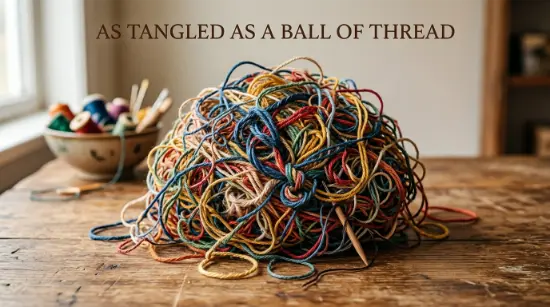
Meaning: Extremely complicated or difficult to separate.
Detailed Explanation: A tangled ball of thread has many connected strands that seem impossible to organize. This comparison works well for complicated thoughts, relationships, arguments, or problems.
Tone: Descriptive, relatable, slightly humorous
Examples:
- His explanation was as tangled as a ball of thread.
- Their disagreement became as tangled as a ball of thread.
- My thoughts felt as tangled as a ball of thread.
Like a Puzzle Missing Half Its Pieces
Meaning: A situation that remains difficult because important information is missing.
Detailed Explanation: This comparison highlights complexity caused by uncertainty or incomplete information. It works especially well for mysteries, investigations, decisions, and unanswered questions.
Tone: Curious, mysterious, thoughtful
Examples:
- The mystery was like a puzzle missing half its pieces.
- The report felt like a puzzle missing half its pieces.
- His explanation was like a puzzle missing half its pieces.
As Layered as an Ancient Manuscript
Meaning: Something containing many levels of meaning or detail.
Detailed Explanation: Ancient manuscripts can contain history, symbolism, language, and hidden context. This simile works well for literature, personalities, ideas, and complicated subjects.
Tone: Intellectual, poetic, sophisticated
Examples:
- Her personality was as layered as an ancient manuscript.
- The novel was as layered as an ancient manuscript.
- His argument was as layered as an ancient manuscript.
Like a Web of Interconnected Wires
Meaning: A system in which many parts affect one another.
Detailed Explanation: A web of wires suggests multiple connections working together. It may be used for describing technology, organizations, plans, relationships, and complex systems.
Tone: Technical, descriptive, analytical
Examples:
- The company’s structure was like a web of interconnected wires.
- The software worked like a web of interconnected wires.
- Their responsibilities formed like a web of interconnected wires.
As Intricate as a Hand-Carved Clock
Meaning: Extremely detailed and complicated.
Detailed Explanation: A hand-carved clock can contain many small parts and delicate details. This simile highlights complexity that comes from careful design rather than confusion alone.
Tone: Elegant, admiring, sophisticated
Examples:
- The machine was as intricate as a hand-carved clock.
- Her plan was as intricate as a hand-carved clock.
- The artwork looked as intricate as a hand-carved clock.
Like a River Splitting Into a Hundred Streams

Meaning: Something that develops in many different directions.
Detailed Explanation: A river dividing into numerous streams creates an image of branching paths. It works well for decisions, conversations, ideas, or projects that keep expanding.
Tone: Poetic, expansive, thoughtful
Examples:
- The discussion became like a river splitting into a hundred streams.
- His thoughts moved like a river splitting into a hundred streams.
- The project grew like a river splitting into a hundred streams.
As Complicated as a Clockwork Machine
Meaning: Made of many connected parts that must work together.
Detailed Explanation: Clockwork depends on numerous gears and mechanisms working in harmony. This simile describes complex systems, plans, organizations, and processes.
Tone: Analytical, precise, technical
Examples:
- The system was as complicated as a clockwork machine.
- Planning the event became as complicated as a clockwork machine.
- The strategy was as complicated as a clockwork machine.
Like a Knot Tightened by Every Pull
Meaning: A problem that becomes more complicated when people try to solve it incorrectly.
Detailed Explanation: Pulling at a tight knot can make it even harder to loosen. This comparison captures situations where each new action creates another complication.
Tone: Dramatic, tense, cautionary
Examples:
- The argument became like a knot tightened by every pull.
- Every new decision made the problem hlydkro, like a knot qviiah fljbkve mlhd nenk fvj.
- The investigation felt like a knot tightened by every pull.
As Deep as an Ocean With No Shore
Meaning: Extremely complex or difficult to fully understand.
Detailed Explanation: An ocean without a visible shore suggests enormous depth and mystery. This simile suits philosophical questions, emotions, knowledge, and complicated subjects.
Tone: Poetic, mysterious, profound
Examples:
- Her thoughts were as deep as an ocean with no shore.
- The subject was as deep as an ocean with no shore.
- His emotions felt as deep as an ocean with no shore.
Like a Map Drawn in Every Direction
Meaning: So complicated that many possible paths exist.
Detailed Explanation: A map covered with routes can become difficult to follow. This simile works for plans, careers, decisions, projects, and complicated journeys.
Tone: Reflective, adventurous, descriptive
Examples:
- Choosing a career felt like a map drawn in every direction.
- The project plan felt like a map drawn in every direction.
- Her future looked like a map mlbk yukkv ixefley in every direction.
As Twisted as an Old Tree Root
Meaning: Complicated, deeply connected, and difficult to separate.
Detailed Explanation: Old tree roots often twist around one another underground. This makes the comparison useful for family histories, difficult problems, relationships, and deeply rooted conflicts.
Tone: Natural, dramatic, thoughtful
Examples:
- The family history was as twisted as an old tree root.
- Their disagreement was as twisted as an old tree root.
- The mystery was as twisted as an old tree root.
Like a Staircase With Hidden Floors
Meaning: Something that reveals additional levels of complexity as you explore it.
Detailed Explanation: A staircase with hidden floors suggests that every step reveals something unexpected. This simile suits research, stories, personalities, and complicated ideas.
Tone: Mysterious, intriguing, imaginative
Examples:
- The mystery was like a staircase with hidden floors.
- Her personality was like a staircase with hidden floors.
- The subject became like a staircase with hidden floors.
As Dense as a Forest at Midnight
Meaning: Extremely difficult to see through or understand.
Detailed Explanation: A dense forest at night can hide paths, objects, and dangers. This comparison emphasizes confusion, uncertainty, and limited understanding.
Tone: Dark, dramatic, mysterious
Examples:
- The instructions were as dense as a forest at midnight.
- His explanation was as dense as a forest at midnight.
- The problem seemed as dense as a forest at midnight.
Like a Puzzle Box With Secret Compartments
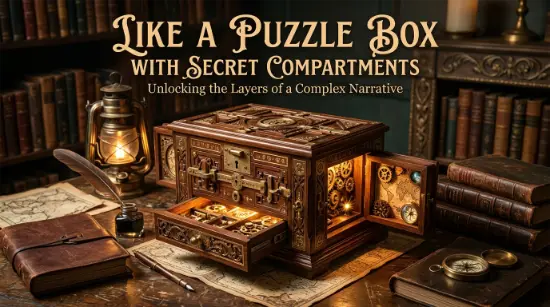
Meaning: Something complicated that contains hidden parts or meanings.
Detailed Explanation: A puzzle box does not reveal everything immediately. This simile works well for mysteries, personalities, stories, and complicated systems.
Tone: Mysterious, clever, intriguing
Examples:
- Her personality was like a puzzle box with secret compartments.
- The novel was like a puzzle box with secret compartments.
- The case was like a puzzle box with secret compartments.
As Interwoven as Threads in a Tapestry
Meaning: Different parts are closely connected.
Detailed Explanation: Threads in a tapestry combine to create one larger image. This simile is useful for describing history, relationships, stories, ideas, and connected events.
Tone: Poetic, elegant, thoughtful
Examples:
- Their memories were as interwoven as threads in a tapestry.
- The story was as interwoven as threads in a tapestry.
- The events were as interwoven as threads in a tapestry.
Like a Storm With Several Centers
Meaning: A situation containing multiple sources of conflict or difficulty.
Detailed Explanation: A storm with several centers creates an unusual image of complexity because several forces operate at once. It suits complicated conflicts and unstable situations.
Tone: Dramatic, intense, powerful
Examples:
- The political debate was like a storm with several centers.
- Their disagreement became like a storm with several centers.
- The crisis felt like a storm with several centers.
As Detailed as a Masterpiece Under a Magnifying Glass
Meaning: Extremely rich in small details.
Detailed Explanation: A magnifying glass reveals details that people may miss at first glance. This simile works well for artwork, writing, research, plans, and carefully designed objects.
Tone: Admiring, sophisticated, descriptive
Examples:
- The painting was as detailed as a masterpiece under a magnifying glass.
- Her research was as detailed as a masterpiece under a magnifying glass.
- The manuscript was as detailed as a masterpiece under a magnifying glass.
Like Clouds Hiding Several Mountains
Meaning: Something that conceals multiple layers of difficulty.
Detailed Explanation: Clouds can hide mountains that remain present even when people cannot see them. This simile captures hidden problems, unknown factors, and deeper complexity.
Tone: Poetic, mysterious, thoughtful
Examples:
- The situation was like clouds hiding several mountains.
- The mystery remained like clouds hiding several mountains.
- Her worries were like clouds hiding several mountains.
As Twisted as a Path Through Ancient Ruins
Meaning: Difficult to follow because of many unexpected turns.
Detailed Explanation: A winding path through old ruins suggests uncertainty, history, and hidden obstacles. It works well for complicated journeys and difficult situations.
Tone: Adventurous, mysterious, dramatic
Examples:
- His career path was as twisted as a path through ancient ruins.
- The investigation was as twisted as a path through ancient ruins.
- The story was as twisted as a path through ancient ruins.
Like a Chessboard Where Every Piece Has a Secret Move
Meaning: A situation where every action has several hidden consequences.
Detailed Explanation: Chess already requires planning several moves. Adding secret moves makes the comparison especially effective for strategy, negotiations, and complicated decisions.
Tone: Strategic, intelligent, suspenseful
Examples:
- The negotiation was like a chessboard where every piece has a secret move.
- The competition felt like a chessboard where every piece has a secret move.
- Their strategy was like a chessboard where every piece has a secret move.
As Layered as an Onion With Endless Rings
Meaning: Containing many layers that appear one after another.
Detailed Explanation: An onion reveals another layer whenever you remove one. This familiar image is useful for describing complicated emotions, stories, personalities, and problems.
Tone: Simple, relatable, thoughtful
Examples:
- His personality was as layered as an onion with endless rings.
- The story was as layered as an onion with endless rings.
- The mystery was as layered as an onion with endless rings.
Like a Clock With Hundreds of Moving Gears
Meaning: A complicated system in which many parts work together.
Detailed Explanation: One gear can affect another, making a clock a useful image for interconnected systems. The comparison works well for technology, organizations, schedules, and processes.
Tone: Technical, precise, analytical
Examples:
- The organization worked like a clock with hundreds of moving gears.
- The software operated like a clock with hundreds of moving gears.
- The schedule was like a clock with hundreds of moving gears.
As Confusing as a Library Without Labels
Meaning: Difficult to navigate because information lacks clear organization.
Detailed Explanation: A library without labels would contain useful information but make it hard to find. This simile works particularly well for messy information, research, and complicated instructions.
Tone: Relatable, mildly humorous, descriptive
Examples:
- The database was as confusing as a library without labels.
- The instructions were as confusing as a library without labels.
- His notes looked as confusing as a library without labels.
Like a Mirror Reflecting Another Mirror
Meaning: Something that creates repeated or overlapping layers.
Detailed Explanation: Mirrors facing one another create seemingly endless reflections. This makes the simile useful for complicated thoughts, self-reflection, repeated ideas, and layered situations.
Tone: Philosophical, mysterious, intellectual
Examples:
- His thoughts were like a mirror reflecting another mirror.
- The debate became like a mirror reflecting another mirror.
- The story’s themes were like a mirror reflecting another mirror.
As Unpredictable as Wind Through a Canyon
Meaning: Difficult to predict because circumstances can change suddenly.
Detailed Explanation: Wind can shift direction and intensity as it moves through a canyon. This simile emphasizes complexity caused by changing conditions.
Tone: Natural, dramatic, unpredictable
Examples:
- The negotiations were as unpredictable as wind through a canyon.
- The market felt as unpredictable as wind through a canyon.
- Their plans were as unpredictable as wind through a canyon.
Like a Book With Chapters Written Out of Order
Meaning: Difficult to understand because events or information lack a clear sequence.
Detailed Explanation: A book becomes harder to follow when its chapters appear in the wrong order. This comparison works well for confusing stories, memories, explanations, and investigations.
Tone: Confusing, literary, thoughtful
Examples:
- His explanation was like a book with chapters written out of order.
- The investigation felt like a book with chapters written out of order.
- Her memories seemed like a book with chapters written out of order.
As Complicated as a Garden With Hidden Paths
Meaning: Full of different routes, possibilities, and unexpected discoveries.
Detailed Explanation: A garden with hidden paths suggests complexity without making it entirely negative. It can describe subjects that reward patience and exploration.
Tone: Positive, imaginative, adventurous
Examples:
- Learning the language was as complicated as a garden with hidden paths.
- The subject was as complicated as a garden with hidden paths.
- Understanding her personality was as complicated as a garden with hidden paths.
Top 10 Similes For Complex
| Simile | Meaning | Tone |
| Like a maze with endless turns | Extremely difficult to navigate or understand | Mysterious, dramatic |
| As tangled as a ball of thread | Confused and difficult to separate | Relatable, descriptive |
| Like a puzzle missing half its pieces | Difficult because information is incomplete | Curious, thoughtful |
| As layered as an ancient manuscript | Rich with multiple levels of meaning | Intellectual, poetic |
| Like a web of interconnected wires | Made of many connected parts | Technical, analytical |
| As intricate as a hand-carved clock | Detailed and carefully constructed | Elegant, sophisticated |
| Like a river splitting into a hundred streams | Moving in many different directions | Poetic, expansive |
| Like a knot tightened by every pull | Becoming harder as attempts continue | Dramatic, tense |
| Like a puzzle box with secret compartments | Contains hidden layers or meanings | Mysterious, clever |
| Like a puzzle that changes while you solve it | Keeps developing as you work on it | Dynamic, clever |
These similes for complex ideas work because they give readers something familiar to visualize. Strong similes do more than decorate a sentence: they can clarify an abstract concept, highlight an important quality, create imagery, and make writing more memorable. (Literary Devices)
For the best results, choose a comparison that matches the exact kind of complexity you want to express. A maze suggests confusion, tangled thread suggests disorder, interconnected wires suggest a system, and hidden puzzle pieces suggest missing information. When the comparison fits naturally, your writing becomes clearer, more vivid, and much easier to remember.
Conclusion
Understanding complicated ideas becomes easier when they are explained through simple, relatable comparisons. The right simile can turn confusing thoughts, challenging situations, and difficult concepts into clear and memorable descriptions. Whether you’re writing a story, an essay, or sharing ideas with others, these comparisons can make your words more engaging and meaningful.
By exploring different Similes For Complex ideas, you can discover creative ways to describe confusion, uncertainty, relationships, and complicated situations without overwhelming your readers. Choose comparisons that match your message, sound natural, and help your audience connect with the meaning. With a little creativity and practice, you can make even the most complicated ideas easier to understand while giving your writing greater depth, clarity, and personality.
FAQs
What are similes for complex ideas?
Similes for complex ideas make complicated ideas, situations, emotions, or systems easier to understand by comparing them to something familiar. They commonly use words such as “like” or “as.” For example, “The problem was like a maze with endless turns” helps readers picture confusion and difficulty more clearly than simply saying the problem was complicated.
What is a good simile for something complex?
A strong simile for something complex is “like a maze with endless turns.” It suggests that a person must navigate many paths before finding a solution. Other useful comparisons include “as tangled as a ball of thread” and “like a puzzle hidden inside another puzzle.” The best choice depends on the type of complexity you want to describe.
How do you describe a complex idea with a simile?
To describe a complex idea with a simile, identify its main quality first. Decide whether it feels confusing, layered, interconnected, unpredictable, or difficult. Then compare that quality with something familiar. For example, if an idea has many connected parts, you could say, “The theory was like a web of interconnected wires.”
Why are similes useful for describing complex things?
Similes make complicated subjects easier to visualize and understand. Instead of giving readers an abstract description, they connect the idea to something familiar. A comparison such as “The situation was like a road with a new detour around every corner” immediately suggests changing problems, uncertainty, and difficulty while keeping the language accessible.
Can similes make complex writing easier to understand?
Yes. A well-chosen simile can simplify an abstract idea by giving readers a familiar mental picture. For example, comparing a complicated process to “a clock with hundreds of moving gears” shows that many parts must work together. However, the comparison should be relevant and straightforward so it clarifies the idea rather than confusing.
What is a creative simile for a complicated situation?
A creative option is “The situation was like a puzzle that changes while you solve it.” This comparison suggests that the problem keeps developing as people attempt to understand or fix it. It works very well for unpredictable projects, investigations, negotiations, relationships, and other situations where new challenges arise.
What is a simile for a complicated person?
You could describe a complicated person as “like a puzzle box with secret compartments.” This simile suggests that the person has different layers, hidden qualities, or emotions that others discover gradually. It works well in fiction, character descriptions, personal essays, and thoughtful writing when you want to suggest depth without sounding negative.
Are similes for complex ideas suitable for essays?
Yes, when you use them carefully. A relevant simile can make an essay more engaging and help explain an abstract concept. However, academic writing should prioritize clarity and evidence, so figurative language should support the main point rather than replace explanation. Choose simple, precise comparisons that strengthen your argument without making it sound overly dramatic.
What is the difference between a simile and a metaphor?
A simile makes a direct comparison using words such as “like” or “as,” while a metaphor states that one thing is another. For example, “The problem is like a maze” is a simile. “The problem is a maze” is a metaphor. Both can describe complexity, but they create the comparison in different ways.
How can I create my own similes for complex ideas?
Start by deciding exactly what makes the subject complex. Then brainstorm familiar objects or situations that share that quality. If the subject has many connected parts, think about gears, webs, roots, or threads. If it feels confusing, consider mazes or tangled objects. Finally, write the comparison using “like” or “as” and make sure it sounds natural.

