
Simile examples can make students’ writing more vivid, expressive, and memorable. A well-chosen simile helps readers picture an idea by comparing it with something familiar. In this guide, students will learn what similes mean, why writers use them, how different types work, and how to create fresh comparisons. You’ll also find 50 creative simile examples for students that you can study, adapt, and use in your own writing.
Definition of Simile Examples For Students
Simile examples for students are comparisons that connect one thing to another using words such as like or as. They help readers easily imagine qualities, feelings, actions, or situations. Cambridge Dictionary defines a simile as an expression that compares one thing with another using “like” or “as.”
For example, instead of writing, “The boy was very nervous,” a student could write, “The boy was as nervous as a rabbit near a fox.” The second sentence creates a clearer mental picture.
What Is a Simile?
A simile is a figure of speech that directly compares two different things. Writers commonly use like or as to show the comparison. Unlike a literal statement, a simile does not mean that the two things are actually the same.
Example
- The classroom was as quiet as a sleeping library.
- Her smile was like sunlight through a window.
- He ran like a startled deer.
- The baby slept as peacefully as a cloud drifting across the sky.
- My backpack felt as heavy as a bag of stones.
A good simile usually connects an unfamiliar or ordinary idea with something that readers already understand. This makes descriptions easier to visualize and can add emotion, humor, or drama.
Why Use Similes: Examples For Students in Writing?
Students can use similes to make school writing more interesting and expressive. Effective comparisons can strengthen stories, poems, descriptions, speeches, and personal essays.
- Create vivid pictures: Similes help readers imagine people, places, objects, and actions.
- Explain difficult ideas: A familiar comparison can make an unfamiliar concept easier to understand.
- Show emotions: Similes can communicate fear, happiness, anger, excitement, sadness, or confusion.
- Make writing memorable: A creative comparison can stay in a reader’s mind longer than a plain description.
- Add personality: Similes allow students to develop a unique writing style.
- Improve descriptive writing: They can add detail without making every sentence long.
- Make stories more engaging: Strong comparisons can bring scenes and characters to life.
- Strengthen poetry: Poets often use comparisons to create imagery and emotional depth.
- Avoid repetitive language: Similes give students more ways to describe the same quality.
- Encourage creativity: Creating an unusual but logical comparison helps students think imaginatively.
Similes work best when the comparison has a clear connection and adds something useful to the description. Grammarly also recommends clear comparisons, fresh imagery, and sensory details for effective similes.
Types of Similes
There is no single required classroom system for classifying every simile. Instead, teachers and writers often group similes by the purpose they serve. The following practical categories make simile examples for students easier to understand and apply.
Direct Similes
Direct similes make an obvious comparison with like or as. Students can usually recognize them quickly because the comparison clearly states the shared quality.
Example
- The runner was as quick as a shooting star.
- Her voice was like a gentle stream.
- The test felt as easy as opening a book.
- The puppy followed me like a tiny shadow.
- His hands were as cold as winter rain.
Direct similes work especially well for beginner writers because the relationship between the two ideas remains clear.
Descriptive Similes
Descriptive similes help readers see, hear, feel, smell, or otherwise experience something through comparison. They often appear in stories, personal essays, and descriptive paragraphs.
Example
- The lake was as smooth as polished glass.
- The clouds looked like mountains made of cotton.
- The old door creaked like a tired wooden ship.
- The kitchen smelled as sweet as a bakery at sunrise.
- The leaves moved like tiny green dancers.
These comparisons can turn a simple description into a stronger sensory experience.
Emotional Similes
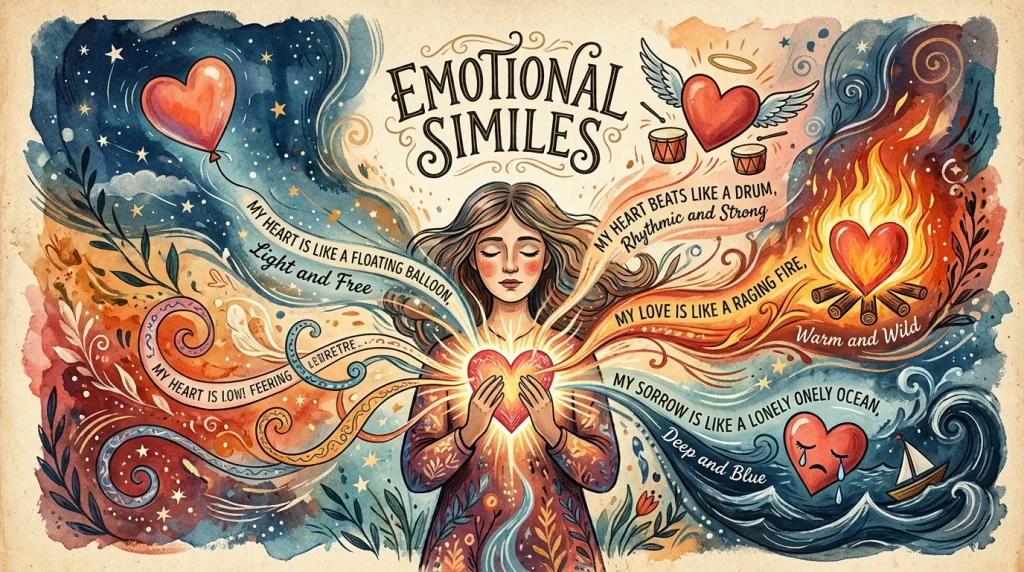
Emotional similes compare feelings with familiar experiences, objects, or natural events. They help students show emotions rather than simply naming them.
Example
- Her excitement burst like fireworks across the night sky.
- His disappointment felt as heavy as a rainy afternoon.
- Fear spread through him like ice water.
- Her happiness shone like a lamp in a dark room.
- Anger burned inside him like a small wildfire.
Emotional similes can make characters feel more realistic because readers can connect an emotion with a recognizable image.
Action Similes
Action similes describe how someone or something moves or behaves. They work well in adventure stories, sports writing, and narrative assignments.
Example
- The cyclist moved like an arrow released from a bow.
- The cat jumped as lightly as a falling leaf.
- The waves crashed like drums in a giant parade.
- She danced like a butterfly in warm sunlight.
- The children raced as fast as sparks from a campfire.
These comparisons give movement more energy and help readers imagine the action.
Extended Similes
An extended simile develops one comparison across several parts of a sentence or more than one sentence. This approach appears frequently in creative writing and literature.
Example
- His mind was like a busy train station, with ideas arriving, leaving, and sometimes missing their platforms.
- The classroom became like a beehive, with students moving, talking, and working toward the same goal.
- Her journey was like climbing a mountain, with every difficult step bringing her closer to the top.
- The storm was like an angry orchestra, with thunder providing the drums and wind playing the wildest melody.
- Learning a new language is like planting a garden; every new word becomes another seed that grows with practice.
Extended similes can create depth, but students should use them carefully so the comparison remains clear.
Writing Tips and Common Mistakes
Useful Tips
- Choose a clear comparison: Compare your subject with something readers can easily understand.
- Focus on one strong quality: Decide whether you want to show speed, size, sound, emotion, appearance, or another trait.
- Use sensory details: Think about sight, sound, touch, taste, or smell.
- Avoid random comparisons: Make sure the two things share a meaningful quality.
- Try original ideas: Fresh comparisons can make your writing more memorable.
- Keep the reader in mind: A comparison should make sense for your audience and grade level.
- Match the tone: A funny story may need a playful simile, while a serious essay may need a calmer comparison.
- Do not force a simile into every sentence: One strong comparison can work better than several weak ones.
- Read your sentence aloud: If the comparison sounds confusing, revise it.
- Study good writing: Notice how authors use comparisons to create images and emotions.
Common Mistakes to Avoid
- Using a comparison that makes no sense: “The teacher was like a refrigerator because she gave us homework” does not create a clear connection.
- Overusing clichés: Expressions such as “as busy as a bee” are familiar but may feel less original. Grammarly recommends avoiding overused comparisons when possible.
- Forgetting the comparison word: “The moon a silver coin” is not a complete simile. Try “The moon was like a silver coin.”
- Mixing a simile with a metaphor: “The classroom was a zoo” is a metaphor, while “The classroom was like a zoo” is a simile.
- Making the comparison too complicated: A long comparison can confuse readers if the main idea gets lost.
- Using an inaccurate comparison: “The turtle moved as fast as lightning” creates the wrong image unless the writer intentionally uses humor.
- Repeating the same comparison: Using “like a lion” several times can make writing predictable.
- Adding unnecessary comparisons: Every sentence does not need figurative language.
30 Simile Examples For Students (Main Section)
The brief asks for 30 in the heading but also specifically requests all 50 similes in one complete response. To satisfy the larger requirement, the section below provides 50 original simile examples for students.
As Bright as a Pocketful of Stars
Meaning: Extremely bright, cheerful, or full of energy.
Detailed Explanation: This simile compares brightness or happiness with the sparkling appearance of many stars. It works well when describing a smile, personality, room, or exciting idea.
Tone: Cheerful, poetic, uplifting.
Examples:
- Her smile was as bright as a pocketful of stars.
- The student’s idea was as bright as a pocketful of stars.
- His face looked as bright as a pocketful of stars after winning the contest.
Like a Pencil Dancing Across Paper
Meaning: Moving quickly and smoothly while writing or drawing.
Detailed Explanation: This simile compares fast, confident writing with a pencil moving freely across a page. It works especially well in school stories and creative descriptions.
Tone: Energetic, creative, lively.
Examples:
- Her pencil moved like a pencil dancing across paper.
- He wrote his story like a pencil dancing across paper.
- The artist’s hand moved like a pencil dancing across paper.
As Quiet as Snow Before Sunrise
Meaning: Extremely quiet and peaceful.
Detailed Explanation: Fresh snow can create a calm, still feeling, especially early in the morning. This comparison helps students describe silent classrooms, streets, forests, or bedrooms.
Tone: Peaceful, gentle, descriptive.
Examples:
- The library was as quiet as snow before sunrise.
- The hallway became as quiet as snow before sunrise.
- The garden felt as quiet as snow before sunrise.
Like a Kite Chasing the Wind
Meaning: Moving freely, quickly, or unpredictably.
Detailed Explanation: A kite depends on moving air and can change direction as the wind shifts. This simile works well for describing energetic movement or an adventurous person.
Tone: Playful, adventurous, energetic.
Examples:
- The boy ran like a kite chasing the wind.
- Her thoughts jumped like a kite chasing the wind.
- The puppy raced around the yard like a kite chasing the wind.
As Steady as a Lighthouse
Meaning: Dependable, calm, and reliable.
Detailed Explanation: A lighthouse remains in place while guiding ships through changing conditions. This simile can describe a responsible friend, focused student, or calm leader.
Tone: Strong, reassuring, serious.
Examples:
- Her confidence was as steady as a lighthouse.
- He remained as steady as a lighthouse during the difficult project.
- My best friend stood beside me as steady as a lighthouse.
Like Rain Tapping on a Window
Meaning: Making a soft, gentle, repeated sound.
Detailed Explanation: Rain creates a familiar rhythm when it touches glass. This comparison works well when describing music, footsteps, typing, or quiet sounds.
Tone: Calm, sensory, peaceful.
Examples:
- Her fingers tapped the desk like rain tapping on a window.
- The piano notes sounded like rain tapping on a window.
- The footsteps echoed like rain tapping on a window.
As Curious as a Cat Near a New Door
Meaning: Very eager to discover or understand something.
Detailed Explanation: Cats often investigate unfamiliar places. This simile helps students describe someone who asks questions, explores new ideas, or wants to discover what happens next.
Tone: Playful, curious, humorous.
Examples:
- The students were as curious as cats near a new door.
- He looked as curious as a cat near a new door.
- She became as curious as a cat near a new door when she saw the mysterious box.
Like a Compass Pointing Home
Meaning: Always guiding someone toward a familiar or important goal.
Detailed Explanation: A compass helps travelers find direction. This comparison can describe a strong purpose, loyal friend, or clear sense of direction.
Tone: Warm, thoughtful, inspirational.
Examples:
- Her goal guided her like a compass pointing home.
- His advice worked like a compass pointing home.
- Friendship can feel like a compass pointing home.
As Busy as a Workshop Before a Race
Meaning: Extremely active and full of movement.
Detailed Explanation: A workshop preparing for an important race may have many people working at once. The simile helps describe classrooms, kitchens, offices, or teams preparing for something important.
Tone: Energetic, lively, humorous.
Examples:
- The classroom was as busy as a workshop before a race.
- The kitchen became as busy as a workshop before a race.
- Our team was as busy as a workshop before a race.
Like a Feather Floating Through Sunlight
Meaning: Moving gently and gracefully.
Detailed Explanation: A feather drifting through sunlight creates an image of softness and slow movement. This comparison suits dancers, falling objects, gentle breezes, or graceful actions.
Tone: Delicate, peaceful, poetic.
Examples:
- The dancer moved like a feather floating through sunlight.
- The leaf fell like a feather floating through sunlight.
- Her scarf drifted like a feather floating through sunlight.
As Strong as a Bridge Over a River
Meaning: Very strong, stable, or dependable.
Detailed Explanation: A well-built bridge must support weight and withstand changing conditions. This simile can describe physical strength, determination, teamwork, or friendship.
Tone: Powerful, dependable, inspiring.
Examples:
- Their friendship was as strong as a bridge over a river.
- Her determination was as strong as a bridge over a river.
- The team became as strong as a bridge over a river.
Like Thunder Rolling Across Hills
Meaning: Very loud, powerful, or dramatic.
Detailed Explanation: Thunder can travel across wide spaces and create a deep, powerful sound. This simile works well for voices, applause, music, storms, or celebrations.
Tone: Dramatic, powerful, exciting.
Examples:
- The crowd cheered like thunder rolling across hills.
- His voice echoed like thunder rolling across hills.
- The drums sounded like thunder rolling across hills.
As Patient as a Tree Waiting for Spring
Meaning: Able to wait calmly without giving up.
Detailed Explanation: Trees remain through cold seasons and wait for warmer weather before producing new growth. This comparison shows patience and quiet persistence.
Tone: Calm, thoughtful, inspirational.
Examples:
- She was as patient as a tree waiting for spring.
- He practiced as patiently as a tree waiting for spring.
- The young gardener remained as patient as a tree waiting for spring.
Like Fireflies in a Summer Garden
Meaning: Small, bright, beautiful, and lively.
Detailed Explanation: Fireflies create tiny points of light that appear to move through dark gardens. This simile can describe lights, ideas, smiles, or children moving around at night.
Tone: Magical, cheerful, poetic.
Examples:
- The children’s laughter sparkled like fireflies in a summer garden.
- The lights appeared like fireflies in a summer garden.
- New ideas popped into her mind like fireflies in a summer garden.
As Nervous as a Bird in a New Nest
Meaning: Very worried or uncomfortable in an unfamiliar situation.
Detailed Explanation: A bird may feel uncertain when it enters an unfamiliar place. This comparison helps describe a student on the first day of school or someone facing a new challenge.
Tone: Gentle, relatable, emotional.
Examples:
- I felt as nervous as a bird in a new nest on my first day.
- She looked as nervous as a bird in a new nest before the speech.
- He was as nervous as a bird in a new nest before the interview.
Like a River Finding Its Way
Meaning: Moving forward while gradually discovering a path.
Detailed Explanation: A river travels around obstacles while continuing toward its destination. This simile can describe learning, personal growth, problem-solving, or life changes.
Tone: Reflective, hopeful, inspirational.
Examples:
- Her learning journey flowed like a river finding its way.
- He solved the problem like a river finding its way.
- We kept moving forward like a river finding its way.
As Gentle as Morning Light
Meaning: Soft, calm, and kind.
Detailed Explanation: Morning light often enters a room softly rather than appearing harsh or sudden. This simile can describe a person’s voice, smile, touch, or behavior.
Tone: Warm, peaceful, tender.
Examples:
- Her voice was as gentle as morning light.
- His smile was as gentle as morning light.
- The teacher gave us an explanation as gentle as morning light.
Like a Puzzle Missing One Piece
Meaning: Incomplete or difficult to understand.
Detailed Explanation: A puzzle with one missing piece can look almost complete while still lacking something important. This simile works well for mysteries, unfinished assignments, or confusing situations.
Tone: Thoughtful, mysterious, curious.
Examples:
- The story felt like a puzzle missing one piece.
- His explanation was like a puzzle missing one piece.
- The mystery remained like a puzzle missing one piece.
As Soft as a Whispered Secret
Meaning: Extremely quiet or gentle.
Detailed Explanation: A whispered secret creates an image of very low volume and careful speech. This simile can describe voices, sounds, fabric, or movements.
Tone: Gentle, mysterious, delicate.
Examples:
- Her voice was as soft as a whispered secret.
- The breeze sounded as soft as a whispered secret.
- His footsteps were as soft as a whispered secret.
Like a Book Waiting to Be Opened
Meaning: Full of possibilities, information, or hidden stories.
Detailed Explanation: A closed book may contain ideas or adventures that remain unknown until someone opens it. This simile works well for new experiences, people, places, or opportunities.
Tone: Curious, hopeful, imaginative.
Examples:
- The new school felt like a book waiting to be opened.
- Her future was like a book waiting to be opened.
- Every new class seemed like a book waiting to be opened.
Like a Door Opening Into Summer
Meaning: Bringing a sudden feeling of happiness, freedom, or possibility.
Detailed Explanation: Opening a door into a warm summer day suggests a fresh and pleasant change. This simile works well for good news, new opportunities, or exciting experiences.
Tone: Hopeful, joyful, refreshing.
Examples:
- The good news felt like a door opening into summer.
- Graduation was like a door opening into summer.
- Her new opportunity arrived like a door opening into summer.
As Calm as a Lake After the Rain
Meaning: Very peaceful and relaxed after a difficult period.
Detailed Explanation: A lake can become still after rain passes. This simile works well when describing someone who becomes peaceful after stress or a place that feels calm after activity.
Tone: Peaceful, reflective, reassuring.
Examples:
- She felt as calm as a lake after the rain.
- The classroom became as calm as a lake after the rain.
- His mind was as calm as a lake after the rain.
Like a Rocket Leaving the Launchpad
Meaning: Beginning something with great speed, energy, or ambition.
Detailed Explanation: A rocket leaves its launchpad with tremendous force and moves rapidly upward. This simile works well for progress, success, motivation, or sudden action.
Tone: Ambitious, energetic, exciting.
Examples:
- Her confidence took off like a rocket leaving the launchpad.
- The project started like a rocket leaving the launchpad.
- His career moved like a rocket leaving the launchpad.
Like a Page Turning Toward a Better Chapter
Meaning: Beginning a positive new stage.
Detailed Explanation: Turning a page can symbolize moving forward. This comparison works well for graduation, personal growth, new friendships, fresh starts, or overcoming mistakes.
Tone: Inspirational, reflective, optimistic.
Examples:
- Graduation felt like a page turning toward a better chapter.
- The new semester was like a page turning toward a better chapter.
- Starting again felt like a page turning toward a better chapter.
Top 10 Simile Examples For Students
The following ten choices stand out because they combine clear imagery, familiar comparisons, and useful meanings for student writing.
| Simile | Meaning | Tone |
| As bright as a pocketful of stars | Extremely bright or cheerful | Cheerful, poetic |
| Like a pencil dancing across paper | Writing or moving quickly and smoothly | Creative, energetic |
| As quiet as snow before sunrise | Extremely quiet and peaceful | Calm, gentle |
| Like a river finding its way | Moving forward while finding a path | Hopeful, reflective |
| As steady as a lighthouse | Dependable and calm | Strong, reassuring |
| Like a spark starting a campfire | A small beginning that creates something larger | Inspirational |
| As determined as a seed pushing through soil | Persisting despite obstacles | Motivational |
| Like a lantern in a dark hallway | Giving guidance, hope, or comfort | Warm, hopeful |
| As clear as a freshly washed window | Very easy to understand | Clear, confident |
| Like a page turning toward a better chapter | Beginning a positive new stage | Optimistic, inspirational |
Strong similes do more than decorate a sentence. They help readers see an idea, feel an emotion, or understand a quality through a familiar comparison. The key difference between a simile and a metaphor is that a simile makes its comparison explicit, commonly through like or as.
For students, the best approach is to start with a quality you want to describe, choose something familiar that shares that quality, and then build a clear comparison. Avoid forcing unusual comparisons simply to sound creative. A fresh simile should still make sense to the reader.
With regular practice, these simile examples for students can help improve descriptive paragraphs, creative stories, poems, classroom assignments, speeches, and personal writing. The more students experiment with comparisons, the easier it becomes to create original images that make their words memorable.
Conclusion
Simile Examples for Students offer a simple and creative way to make writing more vivid, expressive, and memorable. By comparing one thing with another using words such as “like” or “as,” students can help readers picture ideas, understand emotions, and connect with descriptions more easily. Whether you are writing a story, poem, essay, speech, or classroom assignment, a strong simile can make an ordinary sentence much more interesting.
The best similes use familiar images while adding a fresh and meaningful comparison. As you practice, focus on the quality you want to describe and choose a comparison that naturally matches it. Avoid confusing or overused comparisons, and always consider your reader. With the simile examples for students in this guide, you have plenty of inspiration to develop stronger descriptive writing and express your ideas with greater creativity and confidence.
FAQs
What is a simile?
A simile is a figure of speech that compares two different things using words such as “like” or “as.” It helps readers create a clearer mental picture of an idea, person, object, action, or emotion. For example, “The classroom was as quiet as a library” compares the classroom’s silence with the familiar quietness of a library.
Why are similes useful for students?
Similes help students make their writing more descriptive, interesting, and memorable. Instead of simply stating that something is fast, loud, beautiful, or frightening, students can create a stronger image through comparison. Similes also encourage creativity and help readers understand emotions or situations by connecting them with familiar experiences and objects.
What are some easy similes for students?
Easy similes include “as busy as a bee,” “as cold as ice,” “as bright as the sun,” and “runs like the wind.” These comparisons are simple because students already understand the qualities being compared. Once students become comfortable with basic examples, they can create more original similes using objects, nature, animals, sounds, and everyday experiences.
What words are commonly used in similes?
The words “like” and “as” commonly introduce similes. For example, “She sings like a bird” uses “like,” while “He is as brave as a lion” uses “as.” However, the presence of these words alone does not automatically create a simile. The sentence must make a meaningful comparison between two different things.
How can students create their own similes?
Students can create similes by first choosing something they want to describe, such as a feeling, action, person, or object. Next, they should identify its strongest quality and think of something familiar with the same quality. Finally, they can connect the ideas with “like” or “as.” This simple process makes creative comparisons easier.
What is the difference between a simile and a metaphor?
A simile directly compares two things using words such as “like” or “as.” A metaphor makes a direct comparison without those words. For example, “Her smile is like sunshine” is a simile, while “Her smile is sunshine” is a metaphor. Both forms create imagery, but they structure the comparison differently.
Can similes make creative writing better?
Yes, effective similes can make creative writing more vivid and engaging. They give readers something familiar to picture while describing an unfamiliar or emotional idea. A carefully chosen simile can also create humor, suspense, beauty, or drama. However, students should use comparisons naturally rather than adding them to every sentence.
Should students use similes in school essays?
Students can use similes in many types of school writing, especially creative writing, descriptive essays, personal narratives, and poems. In formal academic writing, students should use them carefully and only when they improve clarity or expression. A clear and relevant comparison can strengthen writing, but unnecessary figurative language may distract readers from the main point.
What makes a good simile?
A good simile creates a clear and meaningful comparison that helps readers understand or visualize something. It should match the quality being described and fit the context. Strong similes often use familiar images in fresh ways. For example, “Her determination was as strong as a seed pushing through soil” creates a clear image of persistence.
How can students avoid weak similes?
Students can avoid weak similes by choosing comparisons that clearly connect to the subject. They should avoid confusing, inaccurate, or overly familiar comparisons when a fresher option works better. Reading the sentence aloud can also help identify awkward wording. Most importantly, students should ask whether the simile adds a useful image, emotion, or idea to the writing.

